For those who haven’t bought a ring in years (or have never bought a ring before), it can be nearly impossible to figure out what size ring to order. Inaccurate tools and sizing charts found online make it even more difficult by giving misleading or conflicting information. Generally we recommend using a ring sizing tool similar to one found here at this link. However, there is more than one way to size your finger. This article will give some tips and advice on how you can accurately determine the size of your finger to make sure you order a ring that will fit perfectly.
Common mistakes to avoid
Printable sizing guides found online
Printable ring sizing guides can be useful for getting a rough estimate, but we don’t recommend relying on one when you need an exact size. Printer scaling can cause the guide to print slightly larger or smaller than intended, and even a small measurement error can affect the resulting ring size. If possible, confirm your size with an actual ring sizing tool before ordering.
Measuring the diameter or width of your finger
Similar to the inaccuracy of printable guides, measuring the width of your finger is not a reliable way to determine your finger size. Aside from the difficulty in determining exactly how wide your finger looks next to a ruler, keep in mind that people have different finger shapes – not to mention the width of your fingers can be smaller in cold weather and larger in warm weather. Further, some people will need to order a ring that is slightly larger than their finger’s diameter and circumference if their knuckles are wider than their fingers.
Accurate ways to measure finger size
Purchasing a low cost ring sizing tool
Luckily, there are two common ring sizing tools available for as little as $5 to $10 online that can accurately measure your finger size. The first type is a measuring tape loop that slides over your finger and is pulled closed to give your actual finger size. Be sure to account for any gaps between your finger and the tape as sometimes it won’t lay perfectly flat all the way around the finger. As mentioned earlier, this does not account for knuckle size, but it is a great starting point and by sliding the tape up over the knuckle at the finger size that is measured, you can get a good idea of whether or not you may need to order a half or quarter size larger than your finger’s circumference shows.
The second type of ring sizing tool resembles a keychain holding approximately 25 to 35 plastic or metal rings, each labeled with their ring size. We have one available through our shop here. The biggest advantage to this tool is the ability to feel how a ring will slide over the knuckle when put on. However, the previously mentioned tape measuring style guide has gained popularity over the years because it tends to be a little less clunky to keep a 2” x 2” low profile tool in your jewelry box compared to a clump of metal or plastic rings.
Visiting a local jeweler
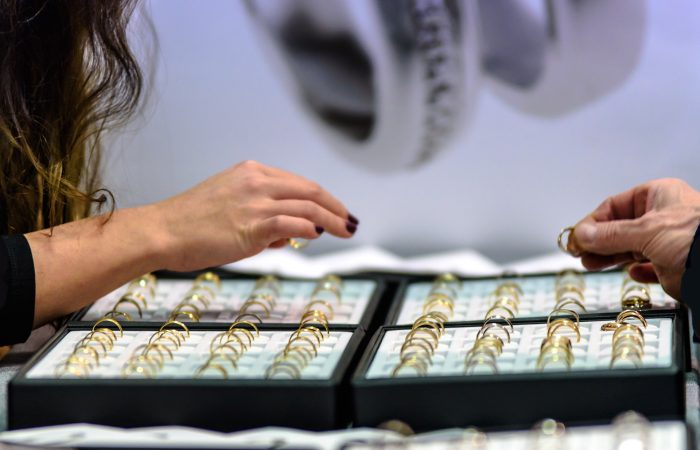
Another reliable option is to visit a local jeweler and have your finger professionally sized. Many jewelry stores will provide this service at little or no cost. An experienced jeweler can also take your knuckle size and the width of the ring into consideration when recommending a size.
Note about wider rings
Wider rings generally fit more snugly than narrow bands, so you may need a larger size than you normally wear. With bands around 5mm or wider, going up approximately a quarter to half size is common. Very wide or heavy bands may require an even larger adjustment. If possible, use a sizing ring that is similar in width to the ring you plan to purchase.
What about purchasing a ring as a gift for someone else?
Buying a ring as a surprise can make sizing difficult. If possible, borrow a ring the recipient already wears on the same finger and have a jeweler measure it. Make sure the borrowed ring is worn on the correct hand and finger, since finger sizes can vary.
If you can’t get an existing ring or an accurate measurement, choosing a size based only on someone’s height or build is unreliable. In that situation, check whether the ring can be resized before purchasing and ask the seller about exchange or sizing options.
A note about getting ring adjusted locally
For many rings, if it just needs a small adjustment, it is easier and faster (and more cost effective) for a jeweler to size a ring up than to size a ring down. This is because many rings can have the back of the band (or “the shank”) slightly stretched up to one full size without needing to cut and re-join the ring back together. If a ring is too large, the only option is to remove a portion of the shank and solder or weld it back together, which is more labor-intensive.
Getting the Best Ring Fit
Taking a few minutes to measure your finger properly can save the trouble of exchanging or resizing a ring later. For the most accurate result, use a physical ring sizing tool or have your finger measured by a jeweler. If you’re ordering a wide ring, remember that you may need to adjust the size slightly for a comfortable fit.
If you’re unsure about sizing for a specific ring, contact us before ordering and we’ll be happy to help.
For more information about gold karats, colors, care, and buying solid gold jewelry, visit our Gold Jewelry FAQ.
Last Updated September 4, 2026